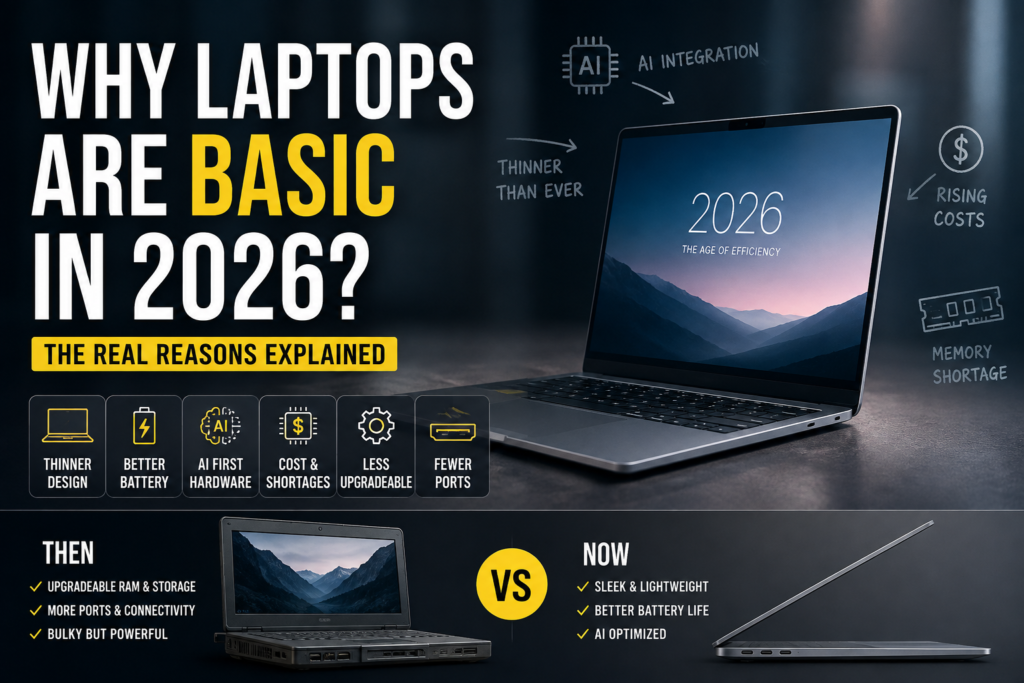
Laptops in 2026 are faster, thinner, lighter, and more efficient than ever. Yet, for many users, they can also feel surprisingly basic. A modern laptop may have a powerful processor, an excellent display, and an AI-focused chip, but still come with limited ports, soldered RAM, modest cooling, and almost no room for meaningful upgrades.
This raises an obvious question: Why have laptops become so basic when technology itself is becoming more advanced?
The answer is not simply that manufacturers are cutting corners. Modern laptops are the result of several competing priorities: portability, battery life, artificial intelligence, manufacturing costs, consumer demand, and the changing role of the PC itself.
The Laptop Has Become More About Efficiency Than Raw Power
One of the biggest changes in laptop design is the shift from traditional performance-focused hardware toward efficiency.
Older laptops often had replaceable batteries, upgradeable RAM, larger cooling systems, multiple USB ports, Ethernet, HDMI, and even optical drives. Today, manufacturers are trying to fit more computing capability into increasingly thin machines.
Modern processors combine CPU, GPU, memory controllers and AI acceleration into highly integrated platforms. This allows manufacturers to reduce motherboard size and power consumption, but it also makes traditional upgrades more difficult.
The rise of ARM-based laptops has strengthened this trend. ARM designs are particularly attractive because of their power efficiency, which helps manufacturers build machines with long battery life without requiring huge batteries or aggressive cooling systems.
In other words, the goal is no longer simply to make the fastest laptop possible. It is to make a computer that delivers enough performance while consuming as little power and space as possible.
AI Is Changing What Laptop Hardware Looks Like
Another major reason laptops feel different in 2026 is artificial intelligence.
Instead of focusing exclusively on CPU and GPU performance, manufacturers now emphasize NPUs—Neural Processing Units designed specifically for AI workloads.
Microsoft’s Copilot+ PC platform, for example, requires an NPU capable of more than 40 trillion operations per second for many of its AI features.
This creates an interesting situation. A laptop might appear relatively ordinary from the outside, while internally it contains specialized hardware designed for AI tasks such as image processing, translation, generative features, and other local AI workloads.
Therefore, some of the engineering effort that previously went into adding physical features is now going into efficiency and specialized silicon.
Thin Designs Come With a Price
There is also a physical limitation that cannot be ignored.
A laptop cannot simultaneously be extremely thin, extremely powerful, highly upgradeable, and completely silent without making compromises.
High-performance processors and GPUs generate heat. Heat requires cooling. Cooling requires fans, heat pipes, vapor chambers, and physical space.
Manufacturers therefore have to choose what matters most for a particular product.
A business ultrabook may prioritize battery life and portability. A gaming laptop may sacrifice thickness for a powerful GPU and better cooling. A workstation may become heavier because sustained performance is more important than portability.
This is why the “basic” appearance of many laptops can actually hide considerable engineering complexity.
Cost and Component Shortages Matter Too
There is another factor that became particularly important in 2026: memory supply and pricing.
IDC forecasts that global PC shipments will decline by 11.3% in 2026, with a persistent memory shortage expected to continue affecting the market into 2027. The shortage is pushing component costs upward and forcing manufacturers to reconsider product configurations.
When memory and other components become more expensive, manufacturers have several choices: increase prices, reduce specifications, redesign products, or concentrate expensive components in premium models.
This helps explain why a laptop that looks similar to last year’s model may not necessarily offer dramatically more hardware for the same money.
The pressure is even greater because AI infrastructure is consuming enormous amounts of memory and other computing resources. Recent industry reporting has highlighted how PC manufacturers are dealing with rising DRAM costs and constrained supply.
Why Don’t Manufacturers Make Laptops More Upgradeable?
This is perhaps the most frustrating part for enthusiasts.
Soldered RAM and storage are common because they save motherboard space, reduce power consumption, simplify manufacturing, and can improve reliability. But the disadvantage is obvious: users lose flexibility.
If your RAM is soldered, you cannot simply install another module later. If important components are integrated into the motherboard, repairing them can become more expensive.
However, this is not technically unavoidable.
Companies such as Framework have demonstrated that thin, modern laptops can still be designed around repairability and upgrades. Its Laptop 13 platform, for example, supports modular components and has maintained compatibility across multiple generations.
The existence of such products proves that manufacturers can prioritize longevity. The bigger question is whether mainstream buyers are willing to pay for it.
The Average Consumer Wants Simplicity
There is also a business reality.
Most laptop buyers do not open their computers. They want something that works immediately, has good battery life, looks modern, connects to Wi-Fi, runs their applications, and lasts several years.
For manufacturers, designing a highly modular laptop can increase engineering complexity and production costs without providing an obvious benefit to the average customer.
That creates a cycle: consumers prioritize convenience and thinness, manufacturers respond with integrated designs, and enthusiast features become concentrated in specialized products.
So, Are Laptops Actually Becoming Worse?
Not necessarily.
In many important ways, 2026 laptops are dramatically better than older laptops. They can offer much better displays, faster wireless connectivity, extremely capable processors, longer battery life, local AI acceleration, faster SSDs, and significantly better performance per watt.
The problem is that technological progress has moved away from features that users can physically see.
A laptop can look almost identical to another machine from five years ago while being vastly more capable internally.
The modern laptop is therefore not really “basic.” It is optimized.
Manufacturers are optimizing for thinness, efficiency, battery life, AI workloads, manufacturing costs, and mass-market demand. The trade-off is that traditional features such as replaceable components, abundant ports, and easy repairability have become less common.
The Bottom Line
The reason laptops feel basic in 2026 is not that laptop technology has stopped advancing. It is advancing in a different direction.
The industry has moved from adding more physical components toward integrating more technology into smaller and more efficient systems. AI accelerators, efficient processors, advanced displays, and battery optimization are now more important than optical drives, removable batteries, or dozens of ports.
For mainstream users, this makes laptops simpler and more convenient. For enthusiasts, however, it can feel like a step backward.
The ideal laptop of the future may therefore not be the one with the most powerful specifications. It may be the one that combines modern efficiency with the old philosophy of repairability, upgradeability, and long-term ownership—something products like Framework are already attempting to prove is possible.